AI
The Frey curve, denoted
, is a specific type of elliptic curve constructed to connect a hypothetical counterexample to Fermat's Last Theorem (

) to a modular form. Its equation is
, representing a curve with very distinct, unusual properties that cannot exist, as proved by Wiles.
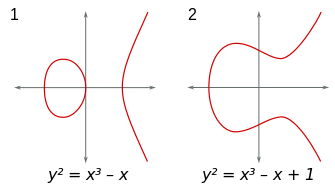
Key Features of the Illustrated Frey Curve:
- Equation: .
- Roots: The curve crosses the -axis at three points:.
- Shape: It is generally drawn as a "singular" or "degenerate" looking curve in specialized scenarios, but it functions as a semistable elliptic curve.
- The Proof Connection: Gerhard Frey proposed that this specific curve, if constructed from a hypothetical solution, is so unusual that it cannot correspond to any modular form. Since Wiles proved that all semistable elliptic curves are modular, the Frey curve cannot exist, meaning no solution to the Fermat equation can exist.
AI Suggested
Elliptic Curves: Fermat's Last Theorem

No comments:
Post a Comment